
October 15, 2026
Recent tax law changes enacted under H.R. 1 may reduce the charitable tax incentives available to some donors, but strategic giving opportunities remain. One strategy worth considering is charitable bunching, especially if you anticipate a higher-income year due to a bonus, commission, business sale, liquidity event, inheritance, or other financial milestone. Donor-advised funds can be particularly effective in supporting this approach.
Charitable bunching involves consolidating multiple years of annual giving into a single year. By making a larger contribution to a donor-advised fund in 2026, for example, you may be able to exceed the standard deduction threshold and benefit from itemizing deductions. In future years, you can continue supporting the nonprofits you care about by recommending grants from your donor-advised fund, even if you do not itemize deductions in those years. This approach can help maximize the tax benefits of your charitable giving while providing flexibility in how and when you support charitable organizations.
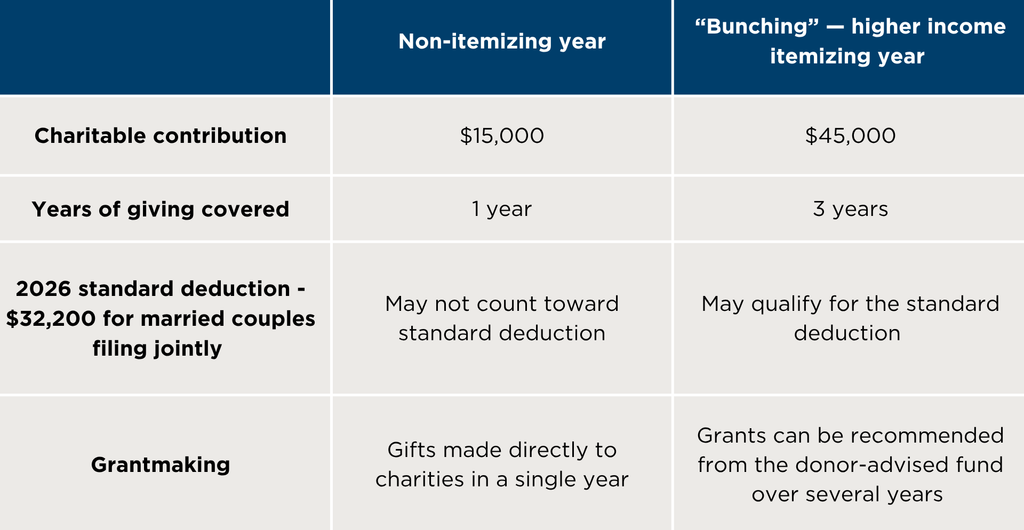
By way of example, a couple gives $15,000 annually to their favorite nonprofit. The 2026 standard deduction for this married couple filing jointly is $32,200 and thus, the annual gift alone will not grant the deduction to this couple. Presuming a high-income year in 2026, if the couple was able to contribute $45,000 to a donor-advised fund, the couple could maximize their tax benefits in 2026 while gifting out $15,000 over a three-year timeframe. This example is illustrated in the chart below.
Charitable bunching presents a compelling opportunity during years of significant financial events. Under H.R. 1, the new 0.5%-of-AGI floor makes this strategy even more relevant, as taxpayers must clear the floor each year they itemize before charitable contributions become deductible. Consolidating several years of giving into one year can help absorb that floor once rather than annually, potentially allowing a larger portion of charitable contributions to be deductible. However, bunching may be less effective for particularly large gifts that exceed the AGI-based limits on charitable deductions, generally 60% of AGI for cash gifts and 30% of AGI for appreciated assets. If you are anticipating a higher-income year, now may be a good time to evaluate whether bunching aligns with your charitable goals and overall financial planning.
A donor-advised fund at Rose Community Foundation can make charitable bunching simple and effective. You can contribute cash, appreciated securities, and other assets such as real estate or business interests, receive an immediate charitable deduction, and in some cases, avoid capital gains, and recommend grants to nonprofit organizations locally, nationally, or internationally.
Rose Community Foundation’s Philanthropic Services team can help you explore giving strategies, learn about community needs, and identify opportunities to make a meaningful impact. As year-end planning approaches, we encourage you to consider whether this may be a year to accelerate your charitable giving and position yourself for both greater impact and potential tax advantages.
As always, we encourage you to consult your tax and financial advisors regarding your specific situation and eligibility for tax benefits.