
October 7, 2026
A healthy democracy requires informed participation. Elections give Coloradans important opportunities to shape the future of their communities by asking voters to consider a myriad of statewide and local ballot measures that could have significant and lasting regional impacts. With ballots landing in mailboxes this week, Colorado voters will have until November 3 to vote in the 2026 midterm elections.
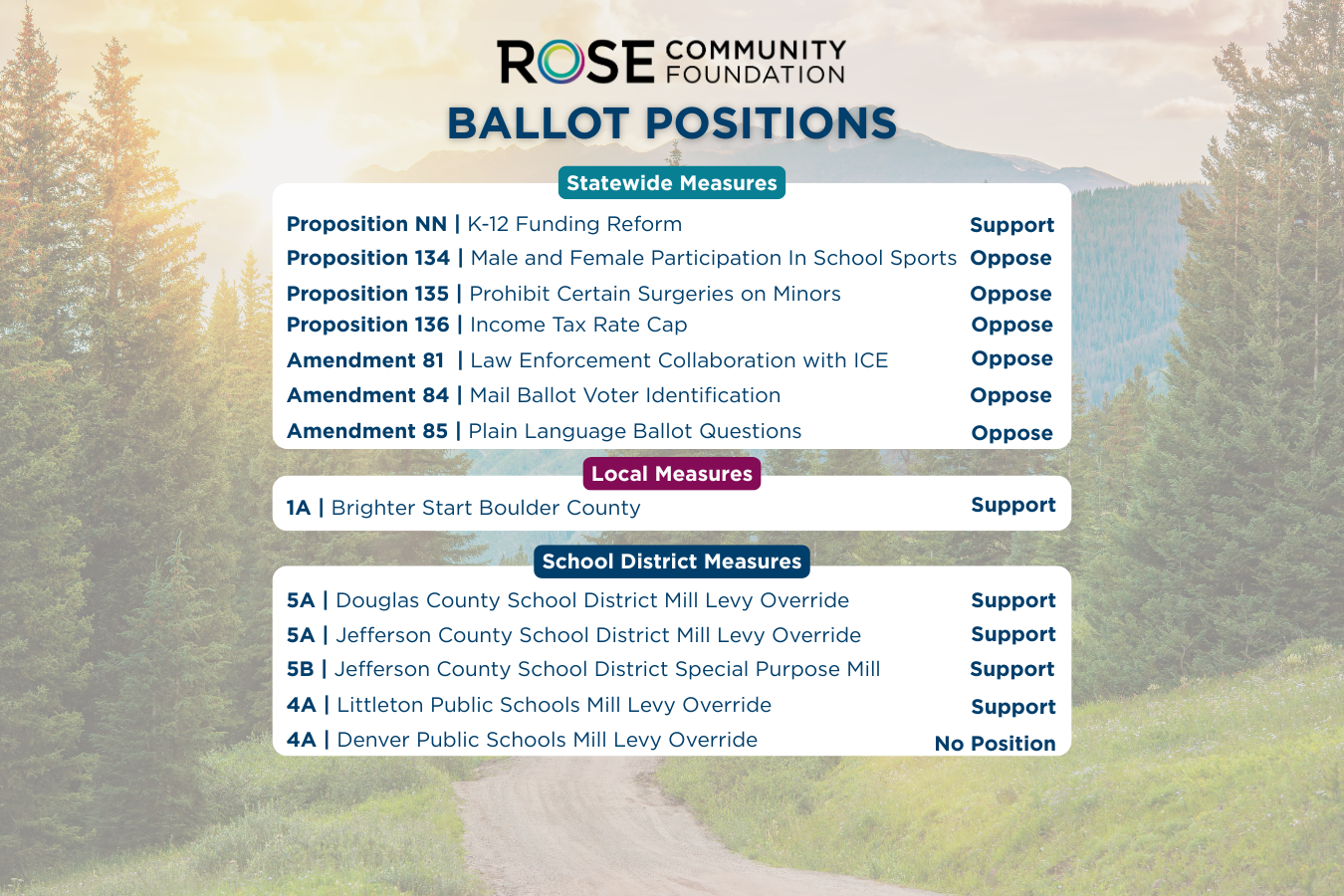
Rose Community Foundation engages in local and statewide policy issues that align with its mission, values and strategic impact areas. In 2026, as in previous years, the Foundation has taken positions on ballot measures that relate to these priorities, with positions reflecting insights received from grantee partners and community advocates across the region, as well as careful review and analysis by our staff, Policy and Advocacy Committee, and Board of Trustees.
Register to vote or check registration status today.
Statewide Measures
Proposition NN | Fiscal Policy: K-12 Funding Reform – SUPPORT
Without increasing the tax rate, Proposition NN would increase investment in Colorado’s K-12 public schools by retaining revenues that would otherwise be returned to taxpayers through TABOR (Taxpayer’s Bill of Rights) refunds. These retained dollars would be used to increase teacher pay, reduce class sizes, and expand career and technical education. Available funds could also be allocated toward services for students with disabilities, childcare and other programs that help children succeed in school. Expanding access to high-quality education, closing learning gaps, and strengthening educational pathways to meaningful employment are central to helping our communities thrive.
Proposition 134 | Male and Female Participation in School Sports – OPPOSE
Initiative 134 would force students – in both K-12 and collegiate athletics in Colorado – to confirm their biological sex to participate on a school sports team, leaving significant questions about how the policy would be enforced. This opens the door to potentially invasive physical examinations and questioning of students whose appearance or gender expression may not conform to traditional gender norms. Transgender youth already participate in sports at significantly lower rates than their cisgender peers, and this measure barring transgender students from participating on school sports teams that align with their gender identity – would be another deterrent from them participating in the same activities as their classmates. This measure ultimately has the potential to contribute to harassment, bullying and discrimination, creating a culture of exclusion rather than one in which all young people can participate, build community and thrive through school sports.
Proposition 135 | Prohibit Certain Surgeries on Minors – OPPOSE
Performing surgery on minors that alters biological sex characteristics is exceedingly rare and highly regulated. These procedures are generally considered medically necessary only after careful evaluation by qualified health care and mental health professionals, consultation with parents or guardians, informed consent, and consideration of established standards of care. By creating a blanket prohibition that exposes health care providers and parents to legal risk for providing or accessing this care, this measure interferes with personal medical decisions made by families and their doctors not only as it relates to transgender youth, but also potentially interfering with medically necessary care for serious conditions that affect kids who are not transgender. We believe families should have the freedom to make private medical decisions without discrimination, intimidation, judgment or government interference.
Proposition 136 | Income Tax Rate Cap – OPPOSE
Rose Community Foundation opposes this measure to cap the state’s individual and corporate income tax rate at the current 4.4 percent because Colorado is already in the midst of a budget crisis created by the artificial constraints of its fiscal policy, and placing a cap on income-tax rates removes one of the few mechanisms the state (with approval from voters) has to generate additional revenue to support schools, health care, transportation, public safety and other critical public programs. Colorado’s financial needs will continue to evolve; maintaining flexibility to respond to future challenges and invest in the services communities rely on is important to the state’s long-term wellbeing.
Amendment 81 | Law Enforcement Collaboration with ICE – OPPOSE
Recent polling from the Colorado Polling Institute indicates that 67% of Coloradans are concerned that federal immigration officials may be detaining the wrong people, while recent polling from the Colorado Health Foundation shows that 65% of Coloradans think violence and misconduct from federal immigration officials is a serious issue. Despite these documented concerns, Amendment 81 would amend the state constitution to give ICE officers increased enforcement access locally.
This proposed constitutional amendment would require local law enforcement to notify U.S. Immigration and Customs Enforcement (ICE) authorities any time an undocumented person – or someone whose immigration status is unknown – is criminally charged rather than convicted, meaning that a person could be reported to federal authorities before their case has been resolved in court, circumventing due process. The measure also doesn’t define what “reasonable effort” must be undertaken to confirm a person’s immigration status, a lack of clarity that could lead to assumptions based on factors such as a person’s race, language or accent, potentially affecting the rights of both citizens and non-citizens, and disproportionately impacting immigrant communities and people of color.
Through the Foundation’s Newcomers Fund and our longstanding support of immigrant- and refugee-serving organizations in our region, we have reinforced the many ways newcomers strengthen our local economy, culture and civic life. We certainly support public safety in general, but this measure would create barriers and fear that make it more difficult for people to access support, report crimes, and contribute fully to the place they call home while potentially creating conditions that make people less safe.
Amendment 84: Mail Ballot Voter Identification – OPPOSE
Colorado’s current mail-in ballot system includes several safeguards before ballots are counted, including signature verification, ballot tracking and procedures to investigate suspected fraud. These measures have helped keep voter fraud in Colorado very rare.
Despite those facts – and in addition to the existing signature verification process – this measure would amend the Colorado Constitution to require voters to include the last four digits of their Social Security number, Colorado driver’s license number, or REAL ID number on the outside of their mail-in ballot envelope, raising serious privacy, identity theft, procedural, and voter suppression concerns.
In general, voter ID laws create additional barriers for eligible voters who may lack the required forms of identification. Given how smoothly Colorado elections have run with very low incidents of fraud, Amendment 84 is a solution in search of a problem that would add unnecessary and potentially risky requirements to the voting process without addressing any actual election integrity needs.
Amendment 85: Plain Language Ballot Questions – OPPOSE
Colorado already has laws requiring accessible ballot language, including recently passed House Bill 26-1320. Yet this measure aims to amend the Colorado Constitution to require all ballot questions to be written in language no higher than an eighth-grade reading level without defining what that actually means, potentially creating uncertainty and legal challenges while limiting the legislature’s ability to adapt ballot-language requirements in the future.
There are concerns that Amendment 85 could also require the removal of existing voter-education tools, including tables showing the impact of tax measures on different income brackets and disclosures explaining how tax changes affect state and local budgets. These requirements, which Rose Community Foundation and many of its community partners supported in the past, help voters understand the potential financial implications of ballot measures.
Given the complexity and importance of the ballot measures on which Coloradans are asked to vote, diminishing accessible and thorough voter information is misguided and harmful.
Local Measures
1A | Brighter Start Boulder County – SUPPORT
Given the success we have seen with the Denver Preschool Program over the past two decades, we are excited that this measure on Boulder County ballots would generate approximately $30 million each year to make childcare and preschool more affordable and accessible for families. Funded through an increase in Boulder County property taxes, this measure would provide financial assistance for families earning less than $150,000, helping reduce the gap between what families can afford and the actual cost of care. Generated revenues would also be invested in childcare facilities, program expansion and support for startups – with a focus on increasing infant and toddler care, where the shortage is especially severe. Together, these investments aim to create a more stable and sustainable early care and education system that works better for children, families, providers and employers.
School District Measures
Rose Community Foundation has a longstanding commitment to education. Adequate funding helps Colorado school districts keep pace with inflation and rising operational costs, retain quality teachers, expand educational programming to improve student outcomes, and address students’ growing safety and mental health needs. The measures below would enable school districts to raise additional local revenue through voter-approved increases to their property tax rates. This funding stays within the district and is managed locally, giving communities a direct role in supporting their schools.
5A | Douglas County School District Mill Levy Override – SUPPORT
Douglas County School District is experiencing budget pressure shaped by state-level funding constraints, recent changes to Colorado’s school funding model, declining enrollment and rising operational costs. Due to these challenges, the district has about $2,000 less per student annually vs. neighboring school districts. The district is requesting a mill levy override to generate $54 million annually for teacher compensation, school resources officers, and career and technical education. Rose Community Foundation’s support for Douglas County School District’s increased funding requests does not constitute agreement with or support for all DCSD policies and procedures, including recent discussion (but no action) around potentially restricting transgender students in sports.
5A | Jefferson County School District Mill Levy Override and 5B | Jefferson County School District Special Purpose Mill – SUPPORT
Jefferson County School District is facing a significant budget deficit this year and recently cut $30 million from its budget. The district is seeking a $73 million mill levy override and a $60 million special-purpose mill in Jefferson and Broomfield counties.
Dollars generated by the mill levy override would be used for staff compensation and career and technical education. While a mill levy funds ongoing operational needs such as teachers, software, enrichment and social-emotional supports, a Special Purpose Mill can be used on capital needs, construction, technology or maintenance. The special purpose mill funds would be used for deferred maintenance including HVAC, parking lots, roofs, updated technology and improved security systems.
4A | Littleton Public Schools Mill Levy Override – SUPPORT
Littleton Public Schools is facing a budget shortfall driven by state-level revenue constraints, ongoing changes to Colorado’s school funding formula, declining enrollment and rising operational costs. To balance this school year’s budget, LPS has implemented staffing cuts, budget reductions and restructuring, an employee wage freeze, and a districtwide furlough day. Without stable, ongoing local funding, LPS will face more significant and permanent cuts in the future.
LPS is seeking a mill levy override to generate $10.2 million annually to close this budget shortfall, support staff compensation, eliminate the planned furlough day, improve school security, and protect the roles of mental health professionals, counselors and support specialists in Littleton Public Schools.
4A | Denver Public Schools Mill Levy Override – NO POSITION
While Rose Community Foundation has supported Denver Public Schools’ bond and mill levy measures in the past, we made the decision to take no position on the 2026 Denver Public Schools (DPS) mill levy override ballot measure. The ongoing contentiousness among DPS board members and between the board and the superintendent – compounded by recent allegations around antisemitism – have been concerning distractions from what should be the district’s core work and raises questions about district leadership’s ability to effectively manage and deploy the resources this mill levy override would generate. We are not actively opposing this measure because we care deeply about the success of DPS schools, teachers, students and families, but we cannot enthusiastically support it until the district’s leadership is able to move past infighting and focus on the students they serve.